

Verra “cannot and should not” verify the Kajiado Rangelands Carbon project in Kenya
"With the carbon projects, you are restricted on your own little piece of land.”

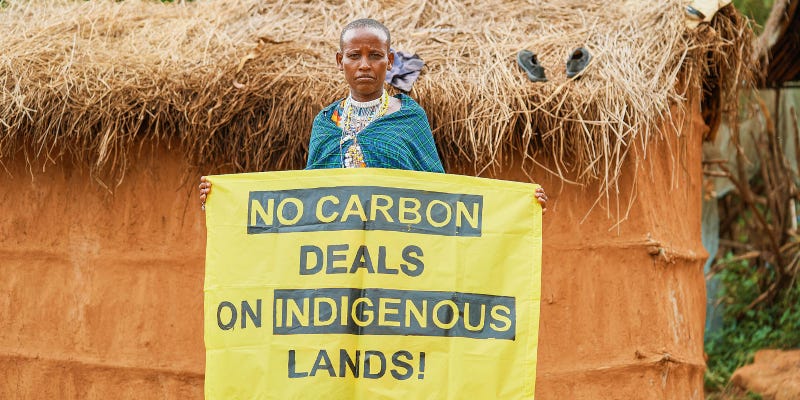
The Kajiado Rangelands Carbon project targets 1.5 million hectares of Maasai land in southern Kenya. The project is being developed by two US companies called Soils for the Future and CarbonSolve. Both companies share the same director and founder, Mark Ritchie. And both companies were incorporated in the tax haven of Delaware.
Ritchie was also one of the lead designers of the Northern Kenya Grassland Carbon Project — a project that Verra suspended twice. Despite an ongoing court case against the project, and the fact that the project failed to carry out a process of free, prior and informed consent before starting, Verra recently reinstated the project.
Ritchie claims that, “it is possible to raise beef in ways that actually remove greenhouse gases from the atmosphere”.
On his LinkedIn profile, Ritchie has a post, the first sentence of which is “Climate positive beef!” This is beef industry propaganda — no need to improve diets by reducing (or eliminating) meat consumption, just buy “sustainable” meat. It’s the same nonsense as carbon neutral fossil fuels.
Ritchie has since deleted the post but the first six lines are still available on his profile:

Belcampo
Ritchie writes about a US meat company called Belcampo. The company claimed to sell “organic, pasture-raised and 100% grass-fed” meat. It owned its own farm, slaughterhouse, restaurants, and butcher shops.
Anya Fernald was the founder and CEO of Belcampo, which she started in 2012. “Ex-vegetarians are our target market,” Fernald told The New Yorker in 2014. “Whole foods plus vegetarianism isn’t going to get a lot of converts. Whole foods plus whole animals is a lot more fun.”
The headline of The New Yorker piece was “Élite Meat.”
In 2004, Fernald met Allan Savory. He’s a rancher from Zimbabwe who came up with an idea he calls “holistic management”. According to Savory, increasing the number of livestock and rotating the grazing can restore the land and address the climate crisis.
Savory’s ideas are not backed by science. But these are the same ideas underlying the massive carbon projects on Maasai and other Indigenous Peoples’ land in Kenya and Tanzania.
Ritchie helped produce Belcampo’s 2020 greenhouse gas inventory. According to a press release, the inventory “demonstrates that its burgers have a net negative impact on carbon emissions”.
By the time that press release came out, Belcampo was facing serious problems.
In 2022, the San Francisco Chronicle obtained 81 pages of US Department of Agriculture Belcampo noncompliance reports dating from January 2020 to November 2021.
These reports “paint a limited yet concerning picture of Belcampo’s plant”, Elena Kadvany, deputy food and wine editor at the San Francisco Chronicle writes.
Pieces of animal meat and fat were strewn throughout Belcampo Meat Co.’s processing plant: on hallways and rugs, the floors of restrooms and an employee break room. In some areas, ants crawled on the abandoned flesh.
Kadvany lists some of the problems revealed in the USDA reports:
the discovery of a leaking, blood-covered box with “discolored” meat inside;
mould growing on pallets;
pork product giving off a “foul smell”; and
improperly labelled meat.
In May 2021, Evan Reiner, a former butcher at Belcampo’s shop in Santa Monica, posted a series of videos on Instagram. The videos showed plastic wrapped beef from Tasmania, boxes of supermarket-brand chicken, and plastic wrapped turkey breast — all in Belcampo’s shop.
“It’s not grass-fed, it’s not organic,” Reiner says.
Reiner said the meat was labelled as organic from Belcampo’s farm, and sold at increased prices. Other Belcampo employees confirmed that the company had been selling mislabelled meat.
Following the scandal, in October 2021, Belcampo closed all its butcher shops and restaurants.
I’m just guessing of course, but I reckon this whole shambles is why Ritchie deleted his post about Belcampo on LinkedIn.
And if Ritchie’s carbon calculations accounted for the fact that Belcampo was selling beef flown in from Australia then I’m the Queen of Sheba.
Jadora
Ritchie was previously Chief Technical Officer at another US company, Jadora LLC, which was run by the notorious Blattner family. In 2021, David Blattner was convicted in the Democratic Republic of Congo of embezzling state funds. He fled to Belgium before the verdict and from there to a luxurious US$2.5 million waterfront apartment in Miami.
The Blattners’ Isangi REDD project in the Democratic Republic of Congo collapsed in 2024. The project had both failed to reduce emissions and failed to improve the livelihoods of the people living in the project area.
The Blattner family is currently developing another REDD project, the Tshopo Lomami REDD project — which is being developed by three companies registered at David Blattner’s Miami apartment.

In 2011, Ritchie wrote a short article in the Jadora LLC Newsletter under the headline, “The Mbirikani Grassland Carbon Project.” The article starts as follows:
Grasslands and savannah ecosystems can store nearly as much carbon in soils as forests do in more visually obvious wood. Changes in the way grasslands are managed could reduce global emissions by 10-15%, and so grassland management offers a new way to generate carbon offsets.
It may be true that changing the management of grasslands could reduce global greenhouse gas emissions by 10-15% (although Ritchie doesn’t provide any evidence in his article). However, generating carbon credits from reduction in emissions wipes out any potential climate benefits, because the reductions are traded against continued emissions from burning fossil fuels elsewhere.
Ritchie explains that Jadora and Soils for the Future have developed a methodology “to generate carbon offsets by managing grazing animals and fire in grasslands and savannahs”.
Back in 2011, Jadora and Soils for the Future were working with the Mbirikani Group Ranch “to restore carbon to the soil of 100,000 ha” of savannah near Amboseli National Park in Kenya. Ritchie writes that,
We are employing a combination of herder education and infrastructure investment to improve water distribution to restore traditional Maasai methods of moving livestock in very large herds rapidly across the landscape.
In 2024, the Mbirikani Group Ranch partnered with the Chyulu Hills REDD project, which is run by Conservation International.
Kajiado
The Kajiado Rangelands Carbon project is already causing problems and generating conflict among the Indigenous Maasai living in the project area. Survival International reports Maasai people describing the project as “a scam to communities” and “neocolonial” in its approach.
They accuse Soils for the Future of luring and tricking people into signing agreements that they don’t understand, and only involving a small number of community members.
Protests broke out in 2025. The community in Oldonyonyokie Group Ranch is opposed to the carbon project. “It’s not transparent, it’s corrupt, and it’s not consent,” one Maasai man commented.
Greenpeace set up a petition in support of the Maasai, urging President Samia Suluhu to reject carbon credit projects. In a statement, Amos Wemanya of Greenpeace Africa says,
“This is climate colonialism, plain and simple. Communities that have lived in harmony with nature for generations are being pushed off their land so that foreign polluters can continue business as usual. Carbon offsetting is not a climate solution, it is a dangerous distraction that sells off our future.”
CarbonSolve and Soils for the Future responded by calling on Greenpeace “to cease and desist communicating any more about these companies or the associated carbon projects, to immediately apologize publicly for the errors in your reporting on your website, and retract your previous statement”.
Survival International
In September 2025, Survival International published a Public Comment on the proposed Kajiado Rangelands Carbon project. On 17 January 2026, Verra posted a redacted version of the comment on its registry.

The following is from the unredacted version of Survival International’s Public Comment.
Survival International notes that the project’s additionality claim is based on the argument that “The rangelands in Kajiado County have seen decades of overgrazing pressure.” But Soils for the Future provides no empirical evidence to support this claim.
Survival International states that,
The lack of any clear evidence for actual decline in vegetation under current Maasai grazing practices calls into question the entire additionality of the project, its future baseline scenarios and indeed its entire rationale.
The method of monitoring the project relies on using a model developed by Mark Ritchie to estimate levels of soil carbon storage from vegetation quality data from satellite images. But vegetation quality is largely dependent on how much rain has fallen. It could be extremely difficult to determine whether changes in vegetation quality (and therefore the amount of carbon in the soil) is a result of changes in grazing patterns or whether it is simply the result of changes in weather patterns.
Survival International points out that there are several legal disputes that could affect the project. One of these involves the 113,000 hectare Ogulului Group Ranch. A legal case is still ongoing about the 2018 election of the leaders of the Ogulului Group Ranch. The Kajiado project signed agreements with people who may not be the legal leaders of the Group Ranch. If new elections are held, there is no guarantee that the new leadership would sign the agreements with the project.
Leakage occurs when livestock in the project area graze elsewhere, or when cattle from outside the project area graze inside it. “Such leakage,” Survival International writes, “will with this project be extremely hard or impossible to monitor, as there are few physical demarcations of the project area”.
Here’s one of the maps that Northern Rangelands Trust produced to track leakage in the Northern Kenya Grassland Carbon Project — which Mark Ritchie was also involved in developing.
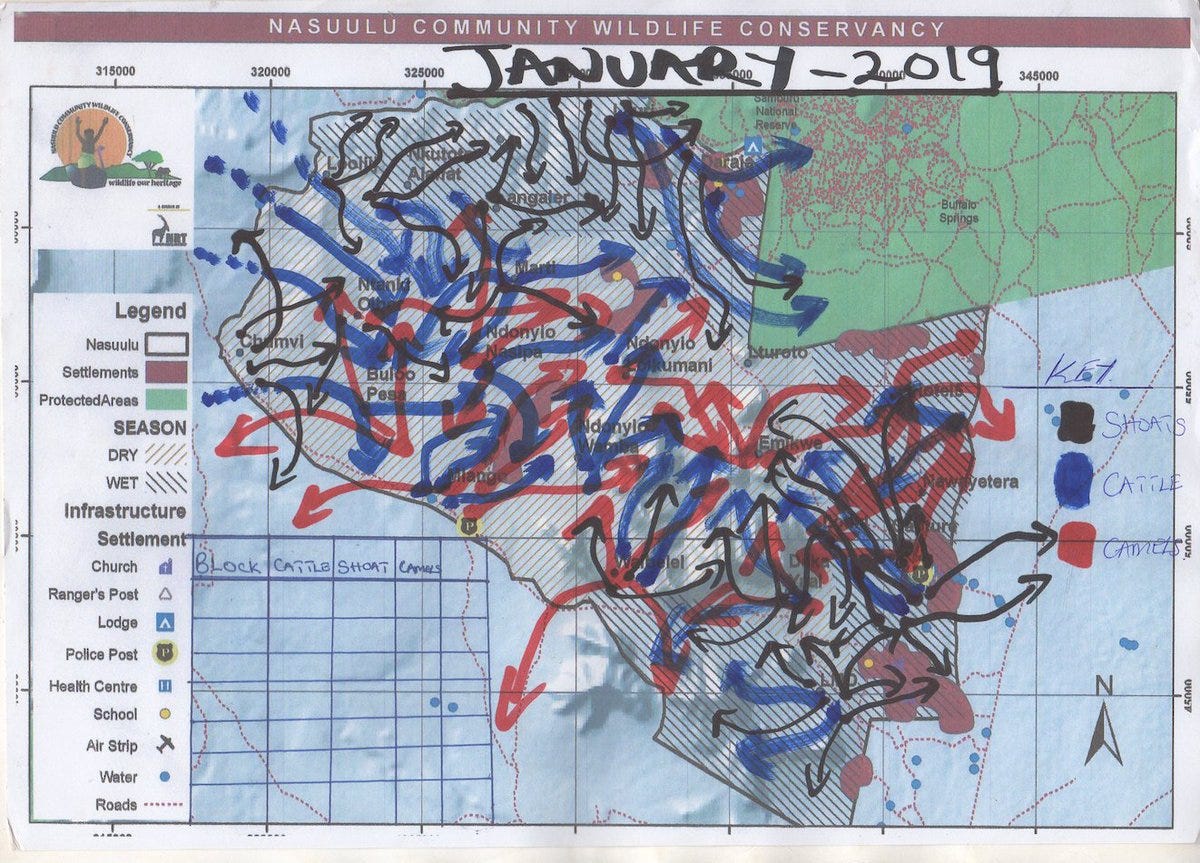
In 2023, Journalist Tin Fischer wrote about the Northern Kenya Grassland Carbon project in Die Zeit. He comments that the maps “do not look reassuring”.
Survival International notes that project documents for the Kajiado project claim that the project will support a return to “traditional” Maasai grazing practices. This is misleading. According to the project document on Verra’s registry, the project will implement a “new system of more intense and higher impact rapid rotational grazing”. This new system is very different to the Maasai’s traditional grazing patterns and does not take account of long-standing cultural knowledge.
“The tradition is that there are no borders,” a Maasai community member from the area told Survival International. “But with the carbon projects, you are restricted on your own little piece of land.”
While the project makes claims about consultation and participation in the development of the project, Survival International’s field research revealed that participation in Soils for the Future’s meeting was limited. The wider community has not been involved, Survival International found.
The Kajiado project will generate carbon credits for Climate Asset Management, a UK-based joint venture between HSBC Asset Management and Pollination.

The project document states that Climate Asset Management’s investment with the project, “secures financial support by committing capital in exchange for the future flow of high-quality carbon credits generated by the project”.
But the agreement between Climate Asset Management and the project is not publicly available. Communities in the project area know nothing about the commercial agreements behind the project’s use of their land to generate carbon credits.
Very little information is available about the plans for benefit sharing. 70% of net benefits will go to communities. That’s after the project proponent and technical partners have taken their cut, validation and verification costs are paid, along with Verra’s fees, local taxes and any other fees that might have to be paid. It’s far from clear whether communities will benefit at all from carbon credits that are sold to Climate Asset Management.
Survival International writes that,
The document refers repeatedly to a “benefit sharing mechanism”, but nowhere describes what this is, how it works, who is involved, who makes decisions, who oversees it and who it is accountable to, etc. Again, this seems to run a very high risk of promoting corruption and other malpractices and fueling community tensions.
The project is currently “Under validation” on Verra’s registry. Survival International concludes that “the project cannot and should not be validated” and that Verra should formally disassociate itself from Soils for the Future and remove its projects from its registry.