

Why is the World Heritage Committee failing to uphold Indigenous Peoples’ rights in the Ngorongoro Conservation Area?
The Tanzanian government has been kicking the Maasai off their land, while claiming that these are “voluntary relocations”.

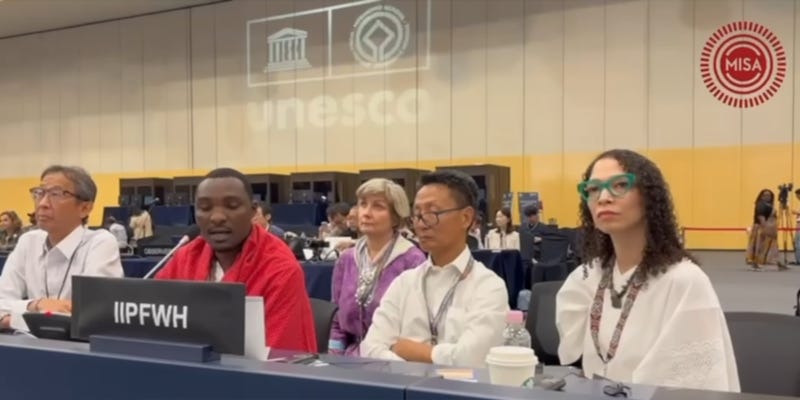
The 48th Session of the UNESCO World Heritage Committee is currently taking place in Busan, South Korea. One of the decisions to be made during the meeting involves the Ngorongoro Conservation Area in Tanzania. The Maasai living in Ngorongoro are facing mass evictions.
In the lead up to the World Heritage Committee meeting, Survival International set up an email action. More than 6,500 people have sent an email to the World Heritage Committee demanding that the evictions stop. “Ngorongoro is Maasai land and they have protected it for generations,” Survival International writes. “No place where such abuse occurs deserves the title of World Heritage Site.”
The Maasai International Solidarity Alliance wrote to the World Heritage Committee calling on them to respect Indigenous Peoples’ rights and international law.

The Oakland Institute also wrote an open letter pointing out to the World Heritage Committee that Ngorongoro cannot be a World Heritage Site and an eviction zone. “If UNESCO cannot ensure that the World Heritage designation protects the rights of its Indigenous custodians,” the Oakland Institute writes, “then the Committee must remove the Ngorongoro Conservation Area from the World Heritage List.”

Adopted without discussion
In Busan, the Maasai International Solidarity Alliance reports that the decision on Ngorongoro “has now been adopted without discussion” by the World Heritage Committee.
“The Committee’s draft decision is still leaning on a framing that rangeland science abandoned decades ago,” Michael Brown, author and consultant, commented on REDD-Monitor. Brown cites several studies that show that “in semi-arid rangelands like Ngorongoro, rainfall variability — not grazing pressure — drives vegetation dynamics, and drought keeps herds well below any theoretical ‘carrying capacity’.”
Brown writes that,
“Consultation” without FPIC [free, prior and informed consent] isn’t a compromise — it’s the same relocation logic with better PR. Delist on hold the line on FPIC; there’s no third option that respects both the science and the people who’ve been managing this landscape the longest.
While the Tanzanian government has cut social services to the Maasai for several years, it is lobbying UNESCO to back a plan to upgrade the main tourist road linking the Ngorongoro Conservation Area and the Serengeti National Park. The government describes this as a “climate adaptation measure” rather than an expansion of tourist infrastructure inside a World Heritage Site. The government is spending about US$4.8 million on roads in Serengeti as part of a plan to increase revenues from tourism.
Masiaya Yonas Laiser represented the Maasai International Solidarity Alliance in Busan and gave a short statement to the World Heritage Committee:
Thank you Mr. Chairperson. I speak before you to represent the Maasai International Solidarity Alliance and Indigenous Peoples’ platform and the Maasai Indigenous People of the Ngorongoro area. We appreciate the Committee’s decisions from previous years which support the continuation of the multiple land-use plan which has served as the foundational basis for the establishment of the Ngorongoro Conservation Area and is based on an agreement with the Maasai Indigenous People that ensured the area to remain a multiple land-use area after their eviction from the Serengeti.
The Maasai firmly condemn any attempt to dismantle this multiple land-use management approach. Doing so would constitute a major violation of our fundamental rights. It would signal a drastic shift in the management framework of this property. Such changes must never be undertaken without the full and effective participation of Indigenous Peoples. Most critically, they require the free, prior and informed consent of the Maasai residents of Ngorongoro.
We strongly echo the Committee’s request that the State Party submit the reports of the full reports of the Presidential Commissions of Inquiry. The State Party continues to reference these documents, yet they remain hidden from both the public and this Committee. The Maasai Peoples of Ngorongoro have contested many times the legitimacy and formation of these Commissions from the outset.
The property has been managed without a General Management Plan for more than ten years now, since the previous plan expired in 2016. This has resulted in management that excludes the Indigenous community and has contributed to unplanned tourism development, including hotels being constructed in environmentally sensitive areas.
True and sustainable conservation cannot exist with human rights violations. Any plan to forcibly relocate the Maasai community from their land as well as the Maasai cultural values in the OUV [Outstanding Universal Value] of the property is detrimental to its integrity.
No conservation without rights, no World Heritage without people!
Thank you chair.
Transparency? Constructive dialogue?
During a side event in Busan, Tanzania’s Ambassador to France and Permanent Delegate to UNESCO, Saidi Yakubu, is reported to have said that the country “believes sustainable conservation of World Heritage Sites depends on transparency, constructive dialogue, and close cooperation between governments, communities living around protected areas, and the international community.”
The Tanzanian government formed two commissions to look at Ngorongoro in December 2024. During the three month process, the commissions were supposed to release their findings at regular intervals. Yet the government shared no information and has still not published the reports.
This is clearly neither transparency, not constructive dialogue.

Instead of listening to the Maasai’s concerns and upholding their rights as Indigenous Peoples, Tanzania has invited UNESCO, IUCN, and the International Council on Monuments and Sites (ICOMOS) to carry out a “Reactive Monitoring Mission” to the Ngorongoro Conservation Area.
To make matters worse, the Tanzanian government appointed Lekisongo Meijo and Lekoko Lepilal to participate in the meeting in Busan. Almost 100 Maasai have signed on to an “Urgent Denunciation” which states that “These individuals are regime-appointed imposters who possess no legitimate, moral, or cultural mandate to speak on behalf of our Maasai community.”
Their denunciation is posted in full below. It is also available in Swahili here.
25 July 2026
To: The Secretariat of UNESCO, the World Heritage Committee (WHC), and all Delegates Attending the WHC meeting in Busan, Korea
Subject: Urgent Denunciation of Fraudulent Representation of Lekisongo Meijo and Lekoko Lepilal as Maasai Representatives at the WHC
We, the Maasai Peoples of Ngorongoro, write to formally denounce the participation of Lekisongo Meijo and Lekoko Lepilal to the 48th Session of the UNESCO World Heritage Committee in Busan, Republic of Korea, where the status of Ngorongoro World Heritage Site was discussed. These individuals are regime-appointed imposters who possess no legitimate, moral, or cultural mandate to speak on behalf of our Maasai community. The government has unilaterally handpicked and embedded these individuals within the official state delegation for a specific political objective, to manufacture the illusion of Maasai consent to relocate. By parading these proxies at international fora like UNESCO, the regime aims to mislead the international community into believing that the Maasai support the ongoing campaigns of “voluntary relocation” while land dispossession and human rights violations are happening in Ngorongoro. This is an attempt by the government to weaponize international platforms to rubber-stamp the eviction of our people from our ancestral lands. We will not let this happen.
Lekisongo Meijo and Lekoko Lepilal should NOT be recognised as Indigenous Maasai representatives but as members of the Tanzanian government delegation.
Here are the reasons why we reject these individuals as our representatives at the UNESCO meeting in Busan:
Illegitimacy Under Maasai Customary Law: Traditional Maasai governance does not recognize a singular “supreme leader,” king, or central chairperson. This autocratic structure is completely foreign to Maasai culture. It has been imposed by are not decision-makers. Rather, their role is to mediate community issues and make sure decisions made are just and considerate.
No Traditional Status: Lekisongo Meijo holds no genuine traditional title. He is not an Alaigwanani (traditional leader), nor has he been granted any temporary mandate to represent Maasai interests in Ngorongoro.
No Geographic or Familial Ties: Neither Lekisongo Meijo nor Lepilal originate from or maintain ancestral roots in Ngorongoro. They hold zero cultural or familial ties to the specific Maasai communities currently facing displacement.
History of State Co-optation: Since 2022, the Tanzanian Presidency and Prime Minister have openly weaponized Lekisongo Meijo as a proxy to divide the Maasai community and falsely claim Maasai backing for state-led forced relocation plans in Ngorongoro. These attempts have failed. Lekisongo is also implicated in the violent operation that took place in Loliondo in 2022.
Violation of International Human Rights Norms: Elevating state imposters to speak for a community targeted through all power and violent machineries of the state directly violates the principle of Free, Prior, and Informed Consent (FPIC). This deceptive arrangement stands in absolute contradiction to the United Nations Declaration on the Rights of Indigenous Peoples (UNDRIP) and the fundamental humanitarian values that UNESCO is bound to uphold.
We urgently request UNESCO and all participating delegates to:
1. Not recognize Lekisongo Meijo nor Lepilal as representatives of the Maasai Indigenous Peoples, and re-classify them exclusively as part of the Tanzanian government delegation.
2. Refuse to recognize any statement, agreements, or concessions made by these individuals regarding Maasai ancestral lands.